The paper behind this story
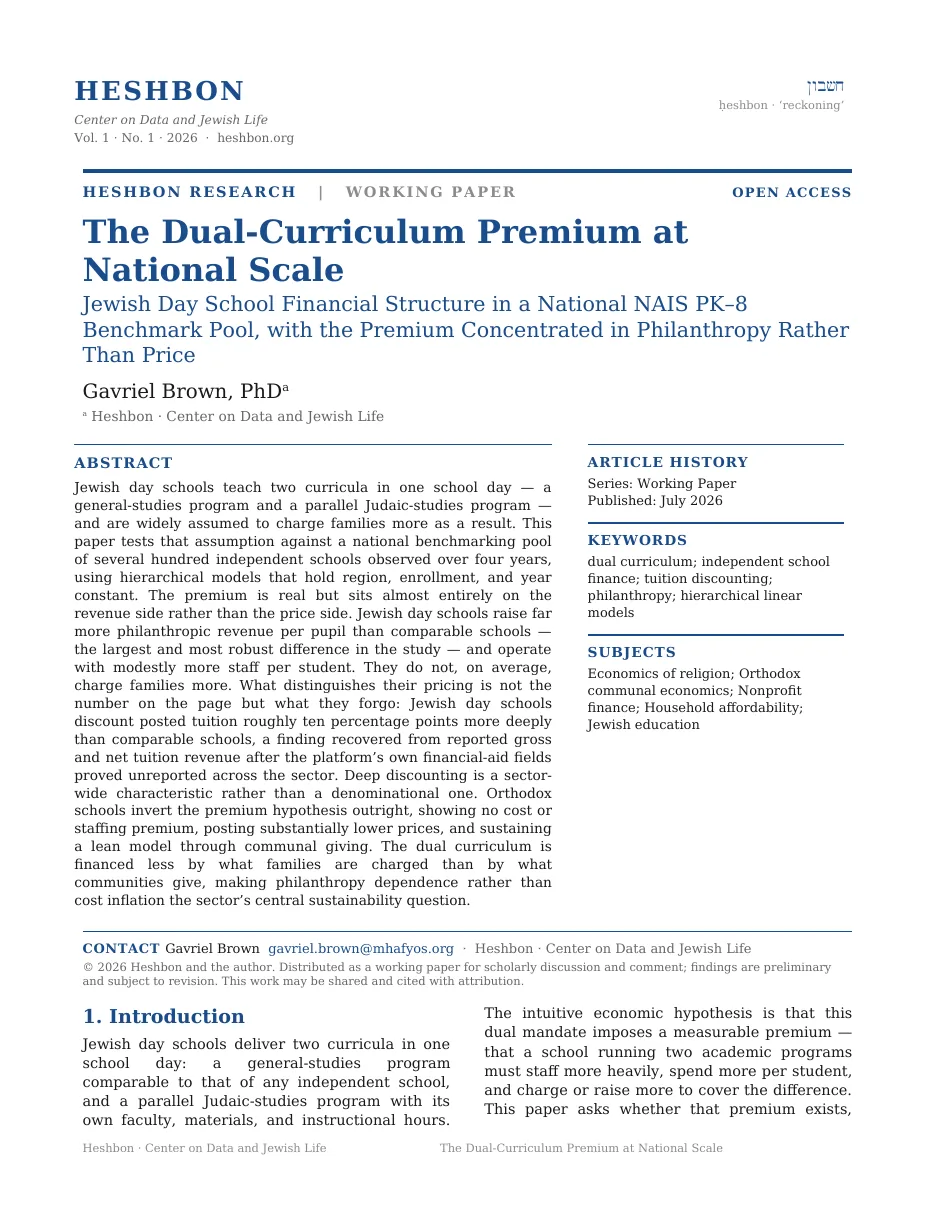
The Dual-Curriculum Premium at National Scale
Running a second faculty and a second set of hours costs money, and nearly everyone assumes the bill goes out to families as tuition. So we rebuilt six financial measures for 101 Jewish day schools and 786 comparable private schools, four school years each, and looked at where the money actually comes from.
An original dataset assembled by hand. The author identified the 101 Jewish day schools from public enrollment rosters and school listings, reviewed each one, and matched them to a like-for-like national pool of comparable private schools. Six financial measures were then reconstructed for every school from public records, filings and archived web captures across 4 school years, from 2022–23 through 2025–26, so each figure rests on a multi-year record rather than a single snapshot.
A comparable-schools peer set enters only as a secondary cross-reference where noted; the findings rest on the assembled record above.
Does the cost of the second curriculum land on tuition?
It does not. The second curriculum costs real money, and the families are not the ones handing it over.
A Jewish day school runs a full general-studies program and a full Judaic-studies program, with separate teachers, separate materials and separate hours. Running two programs costs more than running one, and that cost has to land somewhere. Almost everyone assumes it lands on tuition, that Jewish day school families are paying a premium for the second curriculum. This study sets those schools against a national pool of 887 private schools and adjusts for the obvious differences in size and location. The premium is real and large. It sits somewhere other than where people were looking.
Whatever the second curriculum costs, families are not the ones covering it. Communities are.
If not tuition, then which number is carrying the cost?
Six measures were rebuilt for every school, and each one compares Jewish day schools against private schools of similar size in similar parts of the country. One of the six is not like the others.
The comparison group is not a set of elite, high-endowment flagship prep academies. It is a pool of ordinary independent, community and parochial private schools, the everyday day schools most families actually choose between.
Each Jewish day school is set beside private schools matched on the things that drive cost: enrollment and size, operating budget, campus and facilities, grade range (PK–8), and region and local cost of living. Every figure on this page adjusts for region, enrollment and year, so a Jewish day school in an expensive coastal market is weighed against schools of the same size in the same part of the country, not against rural schools or against famous prep schools with vast endowments.
Each row of the chart below is one of the six measures. The upright line near the left edge is zero, meaning a Jewish day school and a comparable private school come out the same on that measure. Bars run rightward from that line when the Jewish day schools have more of something and leftward when they have less, and the longer the bar the wider the gap. The two rust bars are the rows the whole study turns on; the four slate bars are the rest. The scale underneath is percent difference, except on the discount row, where the unit is percentage points of the published price.
Notice that the top bar runs past the last gridline while the bottom two barely leave the zero line at all.
That top bar is longer than the other five put together. It describes a different way of paying for a school, and it is why the tuition rows read the way they do.
This comparison holds only because the schools are everywhere.
Could that fundraising gap just be the expensive places these schools sit in?
Jewish day schools cluster in costly coastal markets. Compare them against a group that does not, and you end up measuring the price of the neighborhood instead of the cost of the curriculum. So the test is whether the two groups occupy the same map.
Each square below is one state or province, laid out roughly where it falls on a map of North America, with its two-letter abbreviation on top and its school count underneath. The darker the square, the more schools that state holds. The first view is the comparison pool, in slate. The second view is the Jewish day schools, in rust, on their own darkness scale. The third view drops the counts and colours a square teal when both groups are present, pale slate where only comparison schools sit, rust where only Jewish day schools do.
Watch California and New York stay dark as you switch between the first two views.
If the posted price is ordinary and the collected price is ordinary, is the pricing ordinary too?
Published tuition and net tuition both look unremarkable, which seems to settle the question. Put the two side by side, though, and they reveal a third number. The gap between what a school charges and what it actually collects is the discount rate: everything handed back through financial aid, scholarships and tuition breaks. Jewish day schools arrive at an ordinary net tuition by an unusual route.
Each bar below is one group of schools, and its length is the share of the published price that never gets collected. All three start from zero at the left, so a longer bar means a deeper discount. The comparison schools are the slate bar. The two Jewish rows are rust.
Look at where the slate bar stops, then at how far past it both rust bars run.
Does the same pattern hold inside the Orthodox schools?
Half of it does, and half of it runs backward. Orthodox schools show no extra spending and no extra staffing. They post prices about a quarter below comparison schools, hand back the largest discount of any group here, and collect roughly a third less net tuition per student. Communal giving fills the gap, at more than double the comparison rate.
All six measures point the same direction, which is hard to write off as noise even with only eighteen Orthodox schools in the data. The picture is a school running lean and priced low, held up by a community writing checks each year, a model that works right up until the year the checks get smaller.
So: Jewish day schools teach two curricula. Who pays for the second one?
Not the families. The community does, through fundraising per student that runs 161% above comparable private schools while the tuition families actually pay sits 4% below them. The dual-curriculum premium is real. It is collected in donations rather than at the front office, and that makes the sector's finances turn on how much a community gives in a given year rather than on what it charges.
The public filings behind this dataset report total staffing and payroll, not salary figures broken out by subject, so the most direct question, whether Judaic and general-studies teachers are paid differently, cannot be answered here.
It combines need-based aid, merit awards and tuition breaks for employees. This data cannot separate them, so it shows the size of the discount but not who receives it.
Only eleven to fourteen report each measure. Large differences show up clearly; moderate ones would not be detected at all.
Reporting is voluntary and uneven. Schools that report differ somewhat in size from those that do not, and may differ in ways this data cannot see.
An original dataset assembled by hand across four school years, 2022–23 through 2025–26. The 101 Jewish day schools were identified from public enrollment rosters and school listings plus author review, then matched to a like-for-like pool of ordinary independent, community and parochial private schools on enrollment and size, operating budget, campus and facilities, grade range (PK–8), and region and local cost of living. Six financial measures were reconstructed for each school from public filings, school records and archived web captures. All comparisons adjust for region, enrollment and year. Figures were cross-referenced against a peer set of comparable private schools where available; the findings rest on the assembled record.
From The Dual-Curriculum Premium at National Scale, Gavriel Brown, PhD, working paper, July 2026.
The paper behind this story
A data project on how Jewish life is paid for. The work comes in seasons. This page is part of Season 1 — Jewish Education. It states its own sources, sample sizes and limits.
Ahead: Season 2 — Household Affordability · Season 3 — Federation & Charitable Giving
Working prototype. Every figure comes from the underlying research. Where a chart simplifies a published result, the page says so. Nothing here audits an individual school.